The Keepsake Drawer Before the Photo Album
A keepsake drawer preserves the textures, errands and small domestic habits a photo album may miss, helping you choose what belongs in each collection.
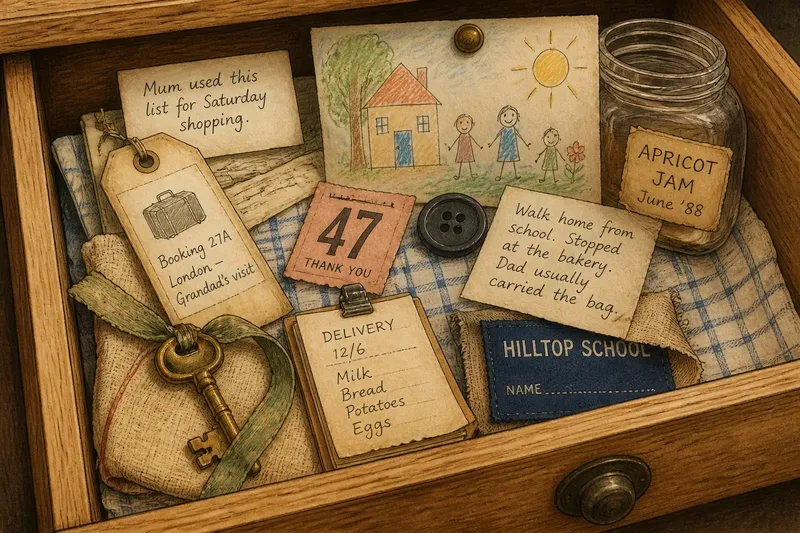
Which household memories would a photo album miss? A keepsake drawer can answer with a bent bus ticket, a button from a familiar coat or the paper label from a jar that once lived by the cooker. These small objects do not arrange a life into chapters. They bring back the particular routines and surroundings that made those chapters feel inhabited.
A chronological album and an object-led collection are not rivals. The album helps you follow what happened; the drawer can recall what a room felt like, what someone carried and what an ordinary day required. Choosing between them depends on the sort of memory you want to keep, and how much sorting you are willing to do.
What objects remember
A photograph often preserves faces, rooms and occasions. A household object can cue memories that have no obvious picture: the stiff tag from a school uniform, a handwritten delivery slip, or the chipped token used to keep a shopping trolley moving. Its meaning may be modest, but the detail it summons can be exact.
That is because objects belong to actions as well as appearances. A recipe card stained at one corner may recall where it was kept, who reached for it, and the change made to the mixture without writing anything down. A key on a faded ribbon can prompt a memory of a particular door and the habit of checking a pocket before leaving.
Object-led recollection also leaves room for uncertainty. You may remember who owned the button but not the year it came loose. Rather than forcing every detail into a timeline, you can preserve what is known and let the unresolved part remain unresolved. A small mystery is not necessarily a filing error.
Three ways to keep things
The most useful approach is the one that matches the way you remember and the amount of context you can supply. These options can sit side by side, but each asks for a different kind of attention.
- The chronological album: Group photographs and notes by year, move or family occasion. This suits someone who often asks what happened next or wants relatives to locate a period quickly. Its strength is sequence; its blind spot is the unphotographed routine between the occasions.
- The keepsake drawer: Keep a small set of objects together, with short notes explaining their connection. This suits a person who remembers by touch, material or daily use, and who prefers a few vivid prompts to a long account. Without labels, though, even a familiar scrap can become an impressive puzzle for everyone else.
- The object-and-story notebook: Photograph or describe each object, then add a few lines about where it came from and what it brings to mind. This suits someone who wants the prompt without keeping every physical item, or who wants relatives to add their own recollections. It asks for a little writing, though not a memoir with a troublesome deadline.
Each form preserves a different kind of information. An album makes order visible; a drawer retains physical presence; a notebook gives a memory enough context to travel beyond the person who first recognised the object.
What belongs in a drawer?
Choose objects with a clear household connection, not merely objects that happen to be old. A worn pantry label, a luggage tag from a regular visit, a child’s drawing pinned beside a phone, or a note left on the kettle may point to repeated habits as readily as to a milestone. The useful question is not whether an item looks important, but what it helps you remember.
Keep a short note with anything whose meaning might fade. A line such as “Mum used this list for Saturday shopping” gives a future reader a starting point without pretending to capture the whole story. Include a name or place only when you know it; a confident guess can quietly turn into family fact.
Say you find a small paper number from the bakery where your household stopped on the walk home. You place it beside a note explaining the route and who usually carried the bag; later, the number may prompt a memory of the warm loaf, the walk and the person waiting at home. The expected result is not a complete account, but a specific scene with several connected details.
For delicate paper, use a clean, dry envelope rather than fastening it with adhesive. Avoid packing damp or crumbly items together, and keep anything that could stain other keepsakes apart. For storage or handling where the right choice depends on a material label, maker’s instructions or local rules, follow those directions or ask a qualified conservator.
Choosing a keepsake approach?
What is the difference between a keepsake drawer and a memory box?
The name matters less than the contents and their context. A drawer suggests objects gathered from household life, while a memory box often holds a more deliberately chosen set; either can work if someone can tell why each item was kept.
Should I keep an object if I cannot identify it?
Keep it only if its material or presence still prompts a memory, and record what you genuinely know. If it has no meaning and no one can place it, letting it go need not erase a story that is not attached to it.
How do I stop a keepsake drawer becoming clutter?
Give it a defined space and choose objects that prompt distinct memories rather than duplicates of the same one. When a new item enters, decide whether an older object still contributes something different; the choice is about the story, not the age of the item.
Can I combine keepsakes with a photo album?
Yes: a photograph can show an object in use, while a note beside the object can explain what the image leaves out. Keep the album’s sequence intact if that is useful, and let the keepsake collection follow its own associations.
A simple way to choose
If you want to trace events in order, begin with the album. If you want a prompt that brings back the texture of ordinary routines, begin with a keepsake drawer. If you want to preserve objects’ meanings without storing the objects themselves, use a notebook, perhaps with photographs.
A keepsake drawer is most valuable when it gives an ordinary thing enough context to open a memory, not when it becomes a museum of household leftovers. Keep the objects that lead somewhere, write down the detail that makes the connection legible, and let the photo album do what it does best: show how one moment followed another.