The Family Saying That Was Never Quite a Rule
A family saying can sound like policy without being one. Learn to read its tone, context and history before treating it as a household rule.
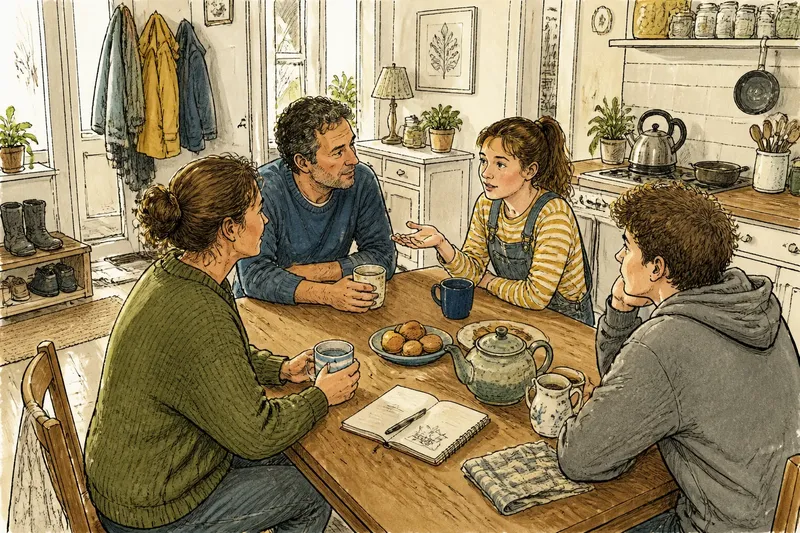
When someone says, “We don’t leave a room without saying goodbye,” do they mean it, or are they repeating the line Aunt May used to say while already halfway down the hall? A family saying can sound like policy without being one. Its meaning often depends on the person, the moment and the way the words are delivered.
That distinction matters because a phrase can carry affection, humour or habit long after its original use has faded. Treating every repeated line as a binding family principle can turn a small bit of household language into a rule nobody remembers choosing.
Words in circulation
A household saying is usually recognisable by its reuse. It might surface at the coat rack, over a saucepan or in the family group chat: “We’ll see what the weather thinks,” “Nobody gets the last biscuit without asking,” or “Leave it for the next person.” Repetition gives a phrase a sense of authority, even when nobody meant to establish a policy.
Listen for what follows the words. If “Leave it for the next person” is said while someone is putting the tea tin back, it may be a practical reminder. If it appears when a sibling takes the last biscuit, it may be playful theatre. The sentence stays the same; its job changes.
There is also a difference between a saying and an explicit agreement. A household may decide that muddy boots stay by the door because the carpet needs protecting. A line such as “The hall is not a field” may accompany that decision, but the joke is not the rule. The reason and the agreed action are easier to discuss than the slogan.
Tone carries evidence
People often infer seriousness from a phrase’s age or frequency. Yet a line repeated for years may have begun as a joke, while a plainly worded request may matter greatly despite being said once. Tone, timing and response offer more useful clues than longevity alone.
- Affection: A saying may be a familiar way to welcome, tease or reassure someone. The listener’s ease and the surrounding warmth help reveal its purpose.
- Humour: Exaggeration, mock solemnity or a deliberately old-fashioned turn of phrase can signal that the speaker is performing a family joke, not issuing instructions.
- Habit: Some words are simply the phrase a person reaches for. They may be repeated without anyone pausing to ask what they mean now.
- Principle: A genuine shared expectation is usually supported by a clear reason and a consistent response when it is not followed.
These categories can overlap. “We don’t waste good string” might be both an affectionate echo of a grandparent and a practical preference for keeping useful scraps. The useful question is not which single label wins, but what the phrase is doing in this particular exchange.
When meaning travels
Sayings often outlive their original setting. A parent may repeat a line from their own childhood without remembering whether it was once a joke, a warning or a request. Children may learn the wording before they know the story, then carry it into a different home with a different sense of emphasis.
Imagine that a family has long said, “We don’t make a fuss about birthdays.” One person uses it to keep celebrations relaxed; another hears it as a reason not to mention wanting a card. If the line is being used to settle a present-day disagreement, the family can ask what each person means by “a fuss” and what they actually want. The phrase then becomes a prompt for a conversation, rather than a verdict.
That matters especially when a saying lands differently with a new partner, a visiting relative or a child who has only heard it as correction. Familiarity to one speaker does not make the meaning obvious to everyone else. A brief explanation—“That’s an old joke, not a rule”—can spare a newcomer the task of decoding a household’s private language by trial and error.
What does the phrase mean?
How can you tell whether a family saying is a rule?
Ask whether people have agreed on a specific expectation and whether they can explain its purpose. If the answer is unclear, treat the saying as an expression of family culture until someone states the practical request directly.
Why do relatives repeat the same phrase?
It may be a memory cue, a joke, a way of showing closeness or simply a well-worn verbal habit. Repetition alone does not tell you which, so notice the situation and the response it invites.
How should you respond when a saying feels like criticism?
You can ask, calmly and specifically, “Are you asking me to do something, or is that the usual saying?” This gives the speaker a chance to clarify without requiring either person to defend the family’s entire tradition.
Can a household keep a saying but change its meaning?
Yes. Families can keep the words as humour or affectionate shorthand while stating any actual expectation separately. A phrase need not be retired just because its old authority has become uncertain.
Keep the useful distinction
If a saying causes repeated confusion, separate its charm from its instruction. Keep the familiar wording if people enjoy it, but add a plain request where one is needed: “We always say ‘leave it for the next person’; today, please refill the kettle before you go.” The practical meaning is now visible, and the old phrase need not carry more weight than it can bear.
It can help to ask an older relative where a phrase came from, but the answer is context, not a ruling. Someone may recall the occasion and still disagree about what the line means today. That is normal; household language belongs to the people using it now as much as to the person who first said it.
When a family saying resurfaces, pause before enforcing it. Notice whether the moment calls for affection, humour, a familiar habit or a clear request. The distinction lets a household keep its private vocabulary without mistaking every well-worn sentence for legislation.
And if nobody can remember who started the saying, that is not a failure of family history. It may simply mean the phrase has become part of the furniture: useful to recognise, but not something anyone needs to obey.